
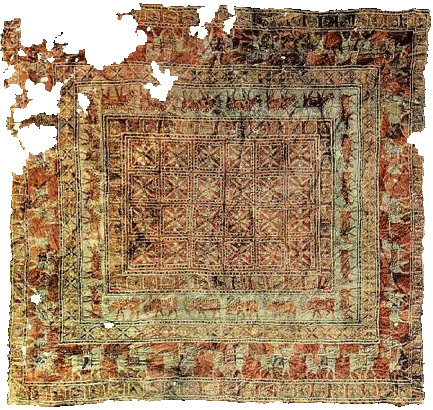
In a unique archaeological excavation in 1949 the exceptional Pazyryk carpet was discovered among the ices of Pazyryk Valley, in Altai Mountains in Siberia. It was discovered in the grave of a Scythian prince by a group of Russian archaeologists under the supervision of Sergei Ivanovich Rudenko. Radiocarbon testing revealed that Pazyryk carpet was woven in the 5th century BC. This carpet is 1.83×2 meters and has 36 symmetrical knots per cm². The advanced weaving technique used in the Pazyryk carpet indicates a long history of evolution and experience in this art. Most experts believe that the Pazyryk carpet is a late achievement of at least one thousand years of technique evolution and history.
This unique piece of art was partly damaged by age and oxidation, but it was preserved in a thick sheet of ice — which had protected it for twenty-five centuries. Late in 1929, a Russian ethnographic mission led by Rudenko and Griaznov began the excavation of five tumuli dating from the Scllhian period. The tumuli had been discovered in the Pazyryk valley, in the Altai mountains, 5400 feet above sea level, and some six miles from the border of Outer Mongolia. In 1949 during the excavation of the fifth tumulus, a magnificent carpet came to light which today represents the most important piece of evidence in the history of Oriental Carpets. This is the only rug from the Achaemenid period known and preserved up to the present day.
Although it was found in a Scjythian burial-mound, most experts attribute it to Persia. Its design is in the same style as the sculptures of Perspolis, The outer of the two principal border bands is decorated with a line of horsemen: seven on each side, twenty-eight in number — a figure which corresponds to the number of males who carried the throne of Xerxes to Perspolis). Some are mounted, while others walk beside their horses. In the inner principal band there is a line of six elks on each side. The two external guards are decorated, with a succession of small squares containing imaginary creatures, probably griffins. The original colours used for this carpet are not known as they have almost faded away. The Pazyryk carpet is of rare beauty and was woven with great technical skill. The Pazyryk carpet compares favourably with that of the best, work from modern sources.
The Pazyryk is now in the Hermitage museum in St.Petersburg,Russia.
****************************
sources: