
A few minutes ago, on Jonbash Rahe Sabz web site, I was reading a letter written by the children of Mir-Hussein Mousavi. It was a letter that made me upset and drove me to thinking. I told myself that I had never wished anyone becoming a pariah. However, I couldn’t help thinking of our own parents and families during the reign of Khomeini when Mr. Mousavi was the prime minister; I couldn’t refrain from sighing.
In their letter, Mir-Hussein Mousavi’s children write:
“We thought whether it is possible to stand behind a door for thirteen days, waiting for a sign or sound that our parents are still there, still alive, still unharmed. Behind a door or gates that never open, lights that never again are turned on.”
“We went to see them one week ago. A van was parked in the alley such that nothing could pass by. The men who came out of the vehicle wore masks. They chewed gum and in answer to our question that what and who gave them the authority to keep us from seeing our parents, they replied harshly, “It is none of your business from where and whom the order has come.” We asked that how many people there were in the van. Again, they answered harshly, “What business of yours is it?” We asked that why their vehicle had such dark, tainted windows. They replied, “What business of yours is it?”
“Wasn’t it really any business of ours where our mother and father were? In the span of seventy two hours, we had become in so many ways strangers!”
And I remembered the summer of 1981. It was the golden years of Khomeini’s reign, and Mir-Hussein Mousavi was his prime minister; Mehdi Karroubi was the head of the Mostazafen Foundation of Islamic Revolution [Bonyad-e Mostazafen va Janbazan]. And I was in prison. My brother, Aref, had been martyred in peaceful demonstrations held on the 30th of Khordad [June 20, 1981]. My husband, Mahmoud, had been arrested and tortured such that for his execution, he had to be carried on a stretcher. While the family mourned the death of my brother and held a memorial service for him in our home, the Revolutionary Guard attacked the house, forcing my parents and the rest of the family to flee.
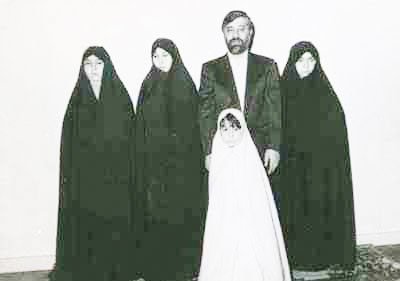
The family house had been confiscated, and according to the neighbors, a grenade was thrown into the yard every day just for the sake of it. The family even didn’t have a place to sleep for months. My father had suffered a heart attack and had developed heart problems after hearing the news of Aref’s martyrdom. My mother was beside herself. My two little sisters innocently were left out of school and became homeless.
Our mother used to say that my sisters always looked at other school children with such envy that broke her heart, but she couldn’t send them to school because the Revolutionary Guard had even gone there to arrest them. Wasn’t it the thirteen year old Fatima Misbah who was executed together with the rest of her family? Has this regime shown mercy to anyone to expect that they would have any compassion on us?
I continued to read the letter written by Mousavi’s children. I noted their words, “In that vast street, it seemed as if even leafless trees shouted, ‘For which crime?’ ”
And I recalled once more the time when our mother told us about the nights they had to sleep in a car in order to avoid arrest; when day after day, they traveled from city to city, merely driving in fear of losing their remaining children or dreading my execution in captivity.
I remembered the time when my sister talked about Mahmoud. My heart still aches for him whenever I think of him. My sister, Efat, used to say, “Together with my husband and two little daughters, I was in a car at an intersection in Tehran. We didn’t have anywhere to go. Recently, we had returned from the northern regions of the country and were searching for a place to stay, but no one was anywhere to be found. All of a sudden, at the intersection, we saw your husband, Mahmoud. He was with a friend and appeared pale. They came into the car, and Mahmoud told us that they had been sleeping on the streets for a while and hadn’t eaten for days.”
My sister added, “Mahmoud suffered from an acute migraine and with empty stomach had taken pain killers.” That night, two friends had gone to a restaurant with my sister and the rest of her family. This was the last time that my family had seen him. Mahmoud was arrested in a few days in the streets of Tehran. Despite being tortured, he had confessed to nothing and remained silent. For this very reason, he was carried on a stretcher to be shot to death by the orders of his executioner, Lajevardi [Asadollah Lajevardi, the warden of Evin from 1981 to 1985].
How lost I was when I heard the news of his execution in prison, when the news of my brother’s murder reached me, when I heard the news of my father’s heart attack but couldn’t do anything for him from prison, when the news of my family’s wandering reached my ears and when I heard about the execution of young relatives one by one in prison.
How abandoned and alone we all felt every night in Evin, counting every finishing shot we heard, reaching as many as three hundred bullets and screaming in our hearts, “For which crime?”
When two of my brother’s friends, Mohammad Haj Hassani and Bijan Kamyab Sharifi, were executed in prison at the age of sixteen; when little Mohammad had called his mother on the night of his execution to ask, “Mother, my entire body is soaked in blood. Is it permissible for me to utter the last prayer covered in blood?” Alas, how lost the parents of Mohammad and Bijan were that night. Yes, how lonesome and forsaken our families were during those times, the era shamelessly remembered by some as the golden years, not the bloody crimson age.
At the present time, the children of Mousavi, the prime minister of “Imam’s golden era,” are the forsaken ones, but I want this for no one. I wish imprisonment and house arrest for no one. I want Mousavi, Karroubi and the rest of them to be set free from the claws of Khamenei’s supporters so that their children don’t feel lost and abandoned.
However, I also wish the day comes that not only Mousavi, Karroubi and those who ruled during the dark ages of Valiayat-e Faqih [Guardianship of Islamic Jurist] but also everyone else, one by one, all of the groups and parties, even those who fought for freedom, will account for the good and the bad they have done. Even if they don’t respond to our questions, they answer to people: What happened during the last thirty three years and how did everyone contribute to what conspired?
Tonight, my heart aches remembering the past. I want a shoulder upon which to cry. The memory of my husband, Mahmoud, whose open arms were mine for no more than six months weighs heavily on my heart. I ask myself, “Who are the forsaken ones?”
The times are peculiar, my dear…
Original article here.
Translated by Laleh Gillani.