
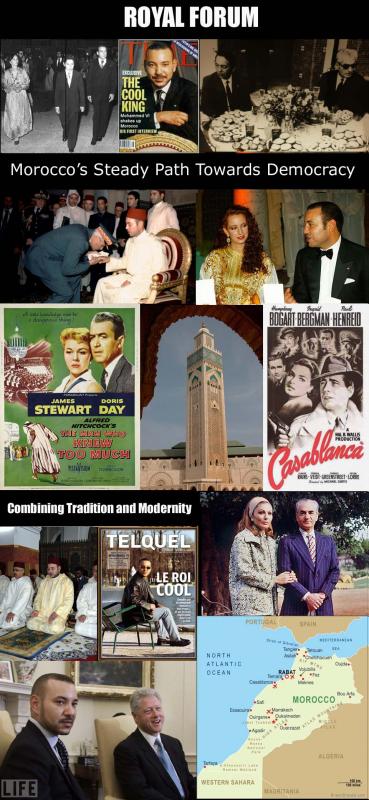
In the ensuing years, Morocco has moved further along thereform road than any of its Arab neighbors. Its press is vibrant and outspoken.An 18-month-old family law no longer treats women as male chattel. Voluntary organizations can be formed with relative ease, and scores of them work oneverything from improving prison conditions to raising the country’s abysmal illiteracy rate.Yet that entire system of law rests not on a framework ofchecks and balances but on the whim of the king. Morocco’s constitution declares the king both sacred and the “prince of the faithful.” Other Arab constitutions do not declare the ruler holy, but an official reverence cocoons virtually every president or monarch in the region. Anyone whochallenges the ruler does so at his own péril.
It is a fact that raises a central question here andacross the Middle East: What is needed to turn states of despotic whim intogenuine nations of law? In Morocco, an essential first step, many reformersbelieve, is an open reckoning with the abuses that this system spawned in thepast.
To this effect an official Equity and ReconciliationCommission, was established in 2004 by the young king, Mohammed VI, to lay barewhat Moroccans often call the terror of his father’s rule and to establishreparations for about 13,000 victims who suffered under the 38-year rule of thelate King Hassan II.
The commission’s public hearings, were without precedentin the Middle East. Royal advisers point to them as evidence of how far alongMorocco is on the road to democratic transformation.
Hassan II was viewed as a dark, Machiavellian figure. Mohammed VI is seen asfar more concerned with humanitarian issues, yet not once since assuming thethrone in 1999 has he ever suggested diluting his role.
France 24 coverage of Morocco’s Parliamentary Elections in 2007 amidst controversy over intimidations:
Euronews Women’s rights in Morocco :
The European Union is now shifting itsfocus to the Euromed nations and Morocco stands out as a country which is nowdemanding ‘special status’. Human rights, particularly towards women, is onearea of focus now for Morocco’s new government, but is it having much impactwith Brussels?
Moroccovotes: Slums breeding extremism – 05 Sept 2007 (Al Jazeera) :
One of the biggest issues in Morocco ispoverty and all of the country’s political parties are promising to tackle theproblem ahead of elections. Slums are a common sight in the cities of thekingdom and some have become a breeding ground for extremism. Al Jazeera’sZeina Awad sent this report from the Sidi Moumen slum in Casablanca.
Riz Khan – Morocco’s Prince Moulay Hicham – 03 Oct 07 :
A member and close cousin of the King ofMorocco speaks about the necessity
ofhaving a purely Constitutional Monarchy
Opinion poll on Mohammed VI ‘illegal’, says minister (France 24, August 2009):
Morocco’sMinister of Communication Khalid Naciri explains the government’s decision toban two magazines which published an opinion poll on the first decade of rule from the north African country’s King Mohammed VI.
Recommended Reading :