

As time passes by in the twilight of one’s career, the most painful predicament is when one becomes aware of ‘so much to learn with so little time available.’ It is always the inadequacies and gaps in my comprehension of universal truth, the very idea of knowing so little and the very dynamic nature of truth, infuriates me sometimes and razes the peace of my mind. Follies of intellect are difficult to argue with. It is a fact that knowledge is bestowed to mankind in dots and drips. I have always maintained that history cannot be judged from our own vantage point. It would be mockery of a fair deal to pass judgments based on realities of today. No knowledge is flawless, neither is any philosopher or a prophet. “Contemporary transformation” and the dominant and invasive modifications taking place throughout all aspects of human existence beg the questions: Where are we potentially heading and, perhaps more importantly, where should we be heading? As I have put it mildly on my introduction on Newsvine under my picture ‘Searching the purpose of our existence and where do we end up?’
We discover truth with the passing of eons. The definition of truth keeps changing; the dynamics of the change is what our minds need to train for. As if ‘facts’ are not fixed, they keep changing over time. Let’s take an example: joblessness causes frustration and extreme anger. Aristotle said that all paid jobs cause degradation of mind. Aristotle could not imagine a society with 1 billion job seekers, this scale of human degradation has inevitably caused momentous strides in research and development. He also postulated that ”the universe is perfect; the Earth is the center of this perfect universe, and that everything in the universe revolves around the Earth.”
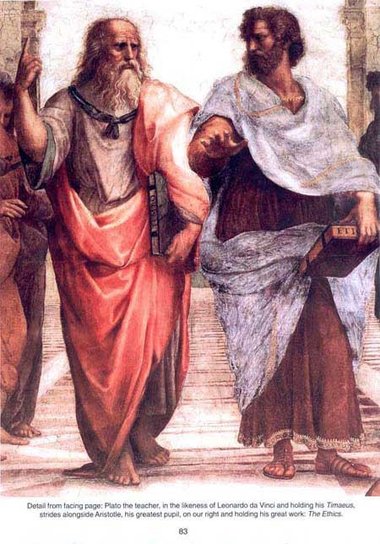
In Athens, his teacher Plato also believed with the Pythagoreans that the stars, planets, Sun and Moon moved around the Earth attached to the surface of crystalline spheres which slid over one another while circumscribed about the five regular solids. Plato founded a school of learning in a place that once belonged to the Greek hero Academos (from whom “academy” is derived). Over the academy’s door was written: “Let no one unversed in geometry enter here.” It flourished for over 900 years, from 387 B.C. to 529 A.D. when it was closed by the Christian emperor Justinian who claimed it was pagan. It sadly remains a time honored tradition of man, that reason and free thinking has always been considered pagan for a holy man.
The claim looks so embellished, the idea so embroidered as we, with the benefit of time and burning at stake of those who disagreed, realize how little of geometry Plato and his generation knew. It is astounding as to why the human race is turning into skeptics, cynics and pessimists? In every challenge we face, be it on the front of the economy or health, instead of recovery we see depression, disease and destruction as our fate. Albeit spanned only over 10,000 years of restricted written history of man (mostly irrelevant in terms of astronomical timelines), the narrative of human life stands as a tangible witness of triumph of man over adversity. The limits and extent of our awareness is swelling exponentially. Disappointingly, most of us remain sheltered within the ‘time frame’ of our physical life or knowledge of the past. So much has changed in the realms of global economy in the last 100 years and on the front of the medicine, yet, when it comes to economic meltdown or pandemics, we keep making comparisons to ‘the Great Depression of 1930’ or the great flu epidemic of 1918. Little do we realize that we are not on the gold standard, and that we have tools which effectively deal with the interconnected global economy in a different way. Printing money was not an option in 1930; it is today. That also goes for the strains of flu we have, that death is caused by the aftermath or the side effects of the flu. But the lines between the pre-penicillin world and post penicillin world are blurred.
It is hip to be pessimistic, and an optimistic person is considered to be “weird.” What an irony! We always imagine the worst but live longer. It is better to live happily and expect the best out of any outcome. That in itself gives a boost of confidence to the fabric of mind. It is the war of minds that needs to be won. If your mind is awake and healthy, your response will be proper and sharp whatever the challenges be. The mind just cannot reconcile the new help that advancements of knowledge of this century bring to answer the disasters of the past. Part of humanity is preoccupied with the dangers of darkness associated with deity, and the other part, the guiltless victims of intense media hype.
From what we know now of the universe, the limited scale of the genesis of human understanding is so humbling. We know that our greatest philosophers and prophets were so imperfect; infallibility of thought is the ‘Achilles’ heel’ of man. Luckily, we can criticize our philosophers without much impunity but forget about prophets. Their sanctified position remains too virtuous to be subject of debate.
Our inability to subject the popular wisdom of “creation” to the test of reason shall be considered by many of us as blasphemous. Noah existed 6000 years or 13.7 billions years ago; that is a miscalculation that we can live with serenely, but the same obstinacy and inflexibility where freedom of thought is moderated by the Holy Scriptures leads to maniacal display of medievalism by extremists of the world.
One cannot even envisage the horrors in 387 B.C. if Copernicus or Galileo entered the academy and would declare the legitimacy of the heliocentric cosmology. Rubbishing earth as the center of universe would have been considered as heretical and blasphemous in the sacrosanct environ of the academy, as it was by the clergy of Rome, nearly 2000 years later. Italian philosopher Galileo Galilei was one of the supreme figures of contemporary science. His rank as a “saint” of the modern world hinges on his discrimination by the Catholic Church for boldly championing the Copernican theory that the earth revolved around the sun, in contradiction to scripture, church tradition and the ancient authority of Aristotle and Ptolemy.
It looks as if destiny has its own time scale. The overthrow of man from the central role of the keeper of the universe was not an easy acceptance by saviors of mankind. Copernicus and Galileo were not entirely correct, that it was the Sun instead at the centre of the Universe and the stars being some bright heavenly bodies of an unknown nature. It was only ‘partial truth.’ The truth remained concealed by the fate from the curious minds of philosophers in the multilayered shrouds of ambiguity. It was as if waiting for the genius of Bruno. Giordano Bruno is known as ‘The Forgotten Philosopher’ who predicted ‘ Infinite Galaxies, Infinite Life.’ He claimed that the sun was only one star among the many thousands, and therefore, like the sun, many other stars also have planets around them and living beings inhabiting them.” By the time Bruno was burned at the stake as a heretic in 1600 on Rome’s Campo dei Fiori for his provocative ideas about the infinity of the universe the Inquisition, condemned him to death in Rome as part of a yearlong jubilee. Giordano Bruno is one of the enormous figures of renaissance Europe. He is an intellectual peer of the greatest thinkers, a thinker whose dream of the world foreshadowed ours.
When science becomes a “cult,” persecution follows. The Pythagoreans who followed the teachings of Pythagoras believed that science was meant only for the chosen few and that commoners should have nothing to do with it. Philosophers can be cruel too; sometimes when reason failed, persecution took over the better part of judgment. Inquisitions and burning at stake was not just a sacred preoccupation, even Pythagoras to his eternal shame sentenced Hippasus to death by drowning.
One story claims that a young student by the name of Hippasus was idly toying with the number √2, attempting to find the equivalent fraction. Eventually he came to realize that no such fraction existed, i.e. that √2 is an irrational number. Hippasus must have been overjoyed by his discovery, but his master was not. Pythagoras had defined the universe in terms of rational numbers and the existence of irrational numbers brought his ideal into question. The consequence of Hippasus’s insight should have been a period of discussion and contemplation during which Pythagoras ought to have come to terms with this new source of numbers. However, Pythagoras was unwilling to accept that he was wrong, but at the same time he was unable to destroy Hippasus’s argument by the power of logic. 1
Judging human course of history from the knowledge of the past is a great attribute. The ability to alter our minds when presented with substantiation that invalidate our beliefs – even our most ingrained ones – is a tough habit to gain, but it is enormously precious. When in doubt, don’t turn away. I am a great proponent of this dictum that, to ‘go forward’, one needs to look at our past, but one error we need to overlook is the error of generalization, and the new paradigms of future should entail the input of new realities. “That which can be destroyed by the truth should be.”
Great philosophers and prophets have made great contributions to human minds but we should accept that all those inputs remain a casualty of time. Though we cannot criticize the philosophers for enunciation of the truth with the benefits that modern times accord us, these time-barred philosophies are our common human heritage and a matter of pride for conscious human beings.
Comparing Newton and Einstein according to Lord May of the Royal society is like comparing apples and oranges, he is so right, the basic postulate of the ‘Theory of General Relativity’ states that a uniform gravitational field (like that near the Earth) is equivalent to a uniform acceleration.
What this means, in effect, is that a person cannot tell the difference between (a) standing on the Earth, feeling the effects of gravity as a downward pull and (b) standing in a very smooth elevator that is accelerating upwards at just the right rate of exactly 32 feet per second squared. In both cases, a person would feel the same downward pull of gravity. Einstein asserted that these effects were actually the same. A far cry from Newton’s view of gravity as a force acting at a distance!
Yet, Royal Society poll in Nov of 2005, Isaac Newton was considered to have had a superior contribution on both science and humankind than Albert Einstein. A total of 1363 members of the public voted online and 345 Royal Society scientists responded to an email questionnaire.The results showed Newton to be the winner on all counts, although opinion was much closer on the overall contribution to humankind. When asked who made the bigger overall contribution to science the public voted 61.8% for Newton and 38.2% for Einstein and the scientists voted 86.2% for Newton and 13.8% for Einstein. Einstein took Physics to a new level but Newton contributions are regarded by the scientist as greater achievements for mankind. Einstein improved our understanding of mysteries of nature but original seed is still regarded as the ultimate ground breaker.
The great thinkers of the past seeded our intellectual legacy to the point of take off; whenever bigotry and orthodoxy has taken the charge of ‘defense of legitimacy’, human progress suffers. Even the brightest of minds in their times make worst of mistakes. Subsequent generations make amends to the farce of errors of our predecessors.
Socrates was forced to drink hemlock. His peers thought he was misleading the youth because he was trying to free the minds of men. 2000 years later, Bruno was burned at the stake for declaring that the universe has billions of suns; the changes of truth do not change the bestiality of man. What one believes is guarded with coercive use of power. Till today, medieval societies use guns to silence opposition. Whenever rational logic and reason fails, persecution will survive. Therefore our real prophets are those who encourage free thinking based on reason and logic where even minor digressions and omissions like, “earth being the centre of the universe”, should be overlooked because they reflect the higher consciousness of man and represent freedom over orthodoxy and bigotry.
We should not worry about smaller threats. Anything within human control can be addressed, but something that will wipe us out might not even realize; it will be far beyond human imagination and scope – implosion of the centre of the earth; solar movements around the centre of the galaxy where we come across new territories or new threats – the very reason we can think of the unthinkable is a luxury that Aristotle or Plato could not. For their vastness of minds “earth was the centre of the universe.” Very geocentric approach but very fertile to seed the future course of mankind. They did not even know the expanse of the universe. For them, stars were like “twinkle twinkle little star;” as they would have gazed them, they would sing this rhyme without much questioning from their peers on the intellect of such a banal nursery construction. Neither are the stars little nor do they twinkle, as we know. They are suns.
We have deciphered knowledge to extended boundaries of fiction. Science fiction is actually our evolutionary fiction. Nothing has been left for future which is improbable, if we can think of ‘cellular transportation of bodies’ through space by ‘beaming up or beaming down’ not much is left to achieve for advanced sciences. What we can think is probably what we can achieve. A cave man could not envision a flying machine he could not build one, Leonardo de Vinci thought of one we build it within four centuries of that vision.
We gaze into the heart of the far away galaxies as Columbus would stand on the shores of Atlantic and try to carve a path through the ocean onto India. The story of human achievements still remains untold, millions of years from now these Hubble’s of ours will be precursors of the ships that will relate to spell bound children of humans in the heart of the far away galaxies the inadequacies of their ancestors minds.
1.Fermat’s Last Theorem-Fermat’s Last Theorem is the true story of how mathematics’ most challenging problem was made to yield its secrets is a thrilling tale of endurance, ingenuity and inspiration.